SEE ALSO: Professional Answers to DoorDash PM Interview Questions
I’ve coached PMs through DoorDash interviews, and here’s what catches people off guard: DoorDash doesn’t want strategists who think for six months before moving—they want operators who can triage a crisis, ship a fix, and optimize it while it’s still running.
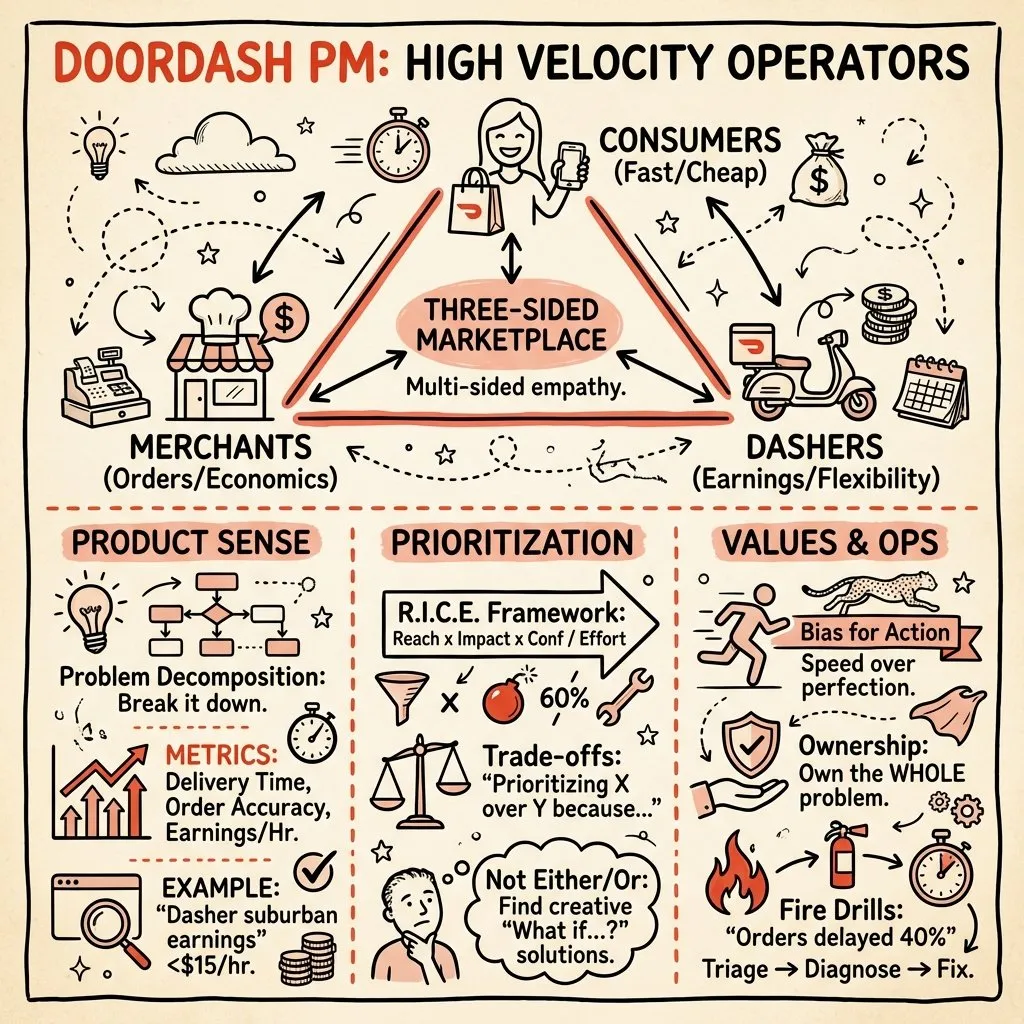
DoorDash PMs are high-velocity operators managing a three-sided marketplace. Every decision you make ripples across consumers who want fast and cheap delivery, merchants who need more orders and better economics, and dashers who want higher earnings and flexibility. Ignore one side and the whole system breaks.
Product Sense at DoorDash means problem decomposition under pressure. Break complex problems down fast. Focus on metrics that matter: delivery time, order accuracy, earnings per hour. Then show you can dig into real scenarios—like “How do you improve dasher suburban earnings when they’re making less than $15/hour?” DoorDash wants PMs who can spot the problem, size it, and move.
Prioritization separates operators from analysts. Use the R.I.C.E. framework: Reach × Impact × Confidence / Effort. A feature that hits 60% of users with high impact wins over something perfect for 5%. Understand trade-offs deeply—“We’re prioritizing X over Y because…” isn’t good enough. Explain the consequences. And avoid either/or thinking. DoorDash rewards PMs who find creative “what if?” solutions that unlock both sides of a trade-off.
Values & Operations is where DoorDash’s culture shows up hardest. Bias for action—ship fast, iterate faster. Speed beats perfection. Take ownership of the whole problem, not just your piece. When things catch fire—and they will, like “orders delayed 40%“—run fire drills: triage, diagnose, fix. Fast.
The brutal reality? If you need consensus before acting or prefer elegant long-term solutions over scrappy fixes, DoorDash will feel like chaos. But if you thrive when everything is moving and breaking simultaneously? You’ll love it.
This cheat sheet maps what DoorDash actually evaluates. Use it to test whether you’re wired for high-velocity operations.