SEE ALSO: Professional Answers to GOOGLE PM Interview Questions
I’ve prepared thousands of candidates for Google PM interviews, and here’s the pattern that separates offers from rejections: Google isn’t testing whether you know the answers—they’re testing whether you can think from first principles when the answers don’t exist yet.
Google PM interviews break down into three core areas: Product Design, Strategy, and Analytical. Each one reveals whether you can hold your own with some of the smartest engineers and PMs in the world.
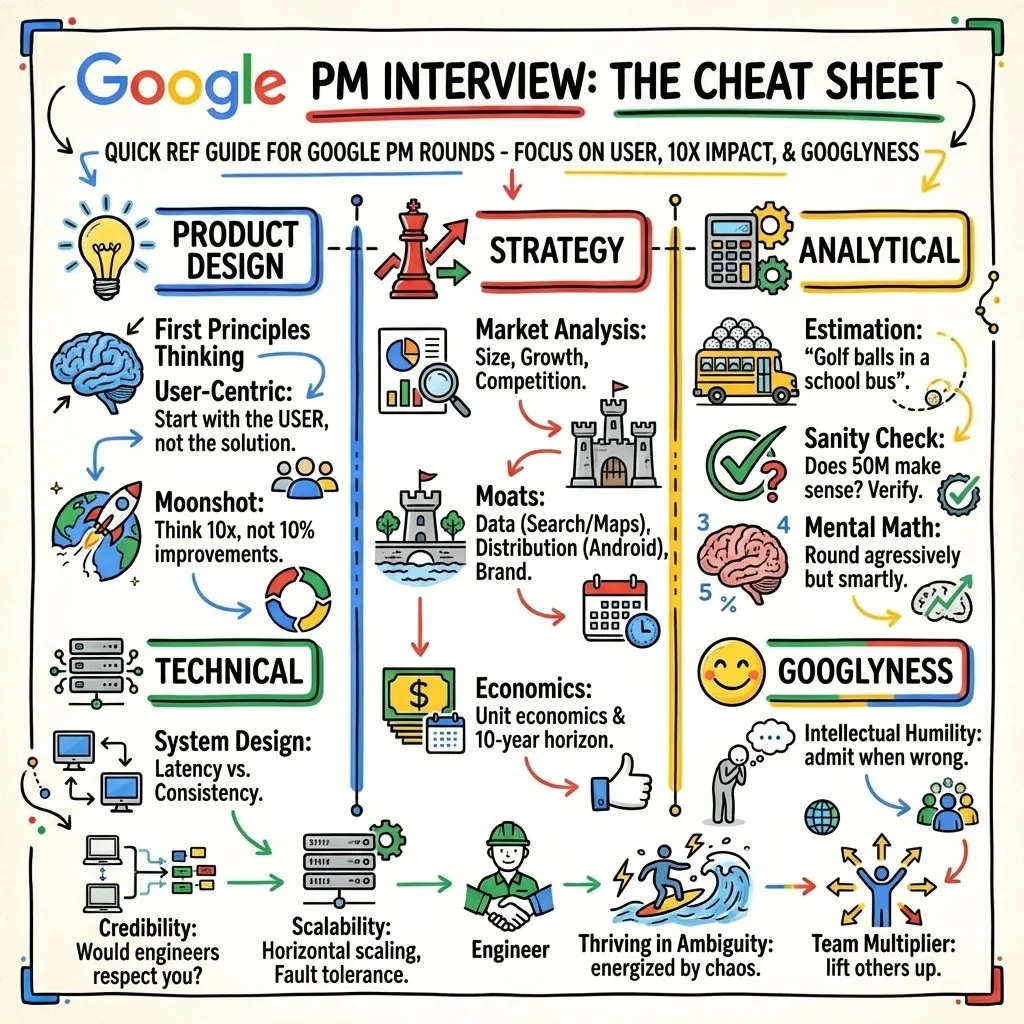
Product Design is about first-principles thinking, not feature lists. Start with the user, not the solution—Google will crush you if you jump straight to features. Think moonshots, not 10% improvements. They want PMs who can reimagine what’s possible, not incrementally optimize what exists. On the technical side, show you understand system design trade-offs like latency versus consistency, and prove you can talk credibly about scalability and fault tolerance. Would engineers actually respect you in the room?
Strategy separates strategic thinkers from feature managers. Analyze the market—size, growth, and competition. Understand your moats: data advantages like Search and Maps, distribution power like Android, brand strength. Know the economics cold—unit economics and how decisions play out over a 10-year horizon, not just next quarter. Google thinks in decades.
Analytical is where candidates crash hardest. Make estimations like “golf balls in a school bus” that show structured thinking, not wild guesses. Run sanity checks—if your math says 50 million when the answer is obviously 5 million, you’ve lost credibility. Round aggressively but smartly to keep the math clean.
Then there’s Googleyness—the cultural filter most candidates underestimate. Show intellectual humility by admitting when you’re wrong. Thrive in ambiguity and get energized by chaos, not paralyzed. Be a team multiplier who lifts others up, not a solo genius.
The stakes are high because Google’s bar is merciless. But if you can demonstrate first-principles thinking, strategic depth, and analytical rigor while staying humble? You’ll earn respect in rooms full of people smarter than you.
This cheat sheet maps what Google actually evaluates. Use it to stress-test whether you’re thinking at the level they demand.