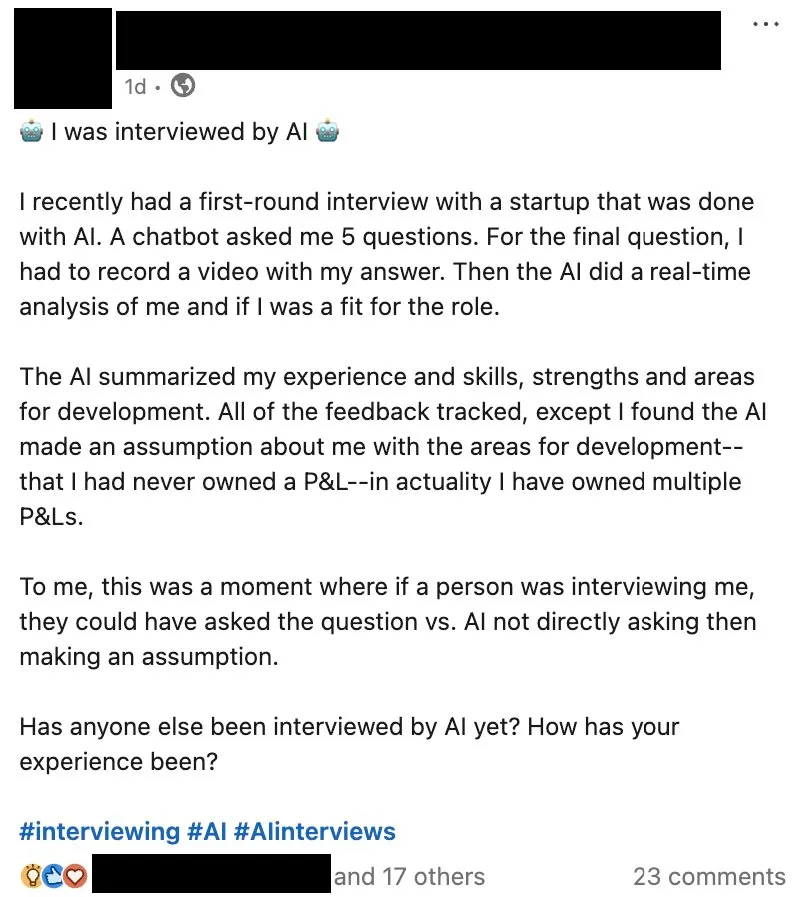
A recent social media post has sparked discussion about the growing trend of AI-powered first-round job interviews. In this particular case, a candidate shared their experience with an automated interview system that asked five questions, including a video response component.
The Interview Experience
The AI conducted the entire first-round screening, analyzing responses and providing real-time feedback on the candidate’s fit for the role. According to the post, much of the AI’s assessment was accurate - evaluating the candidate’s skills and experience relative to the position requirements.
Where AI Falls Short
However, the system made a notable mistake. It incorrectly assumed the candidate had never owned P&L responsibility - an inaccurate assessment of their experience. As the candidate pointed out, a human interviewer would likely have asked follow-up questions to clarify this point rather than making an assumption.
The Deeper Problem: Positivity Bias
While the P&L misidentification highlights one limitation of AI interviews, there’s a more fundamental issue at play. Even when the AI identified supposed “gaps” in experience, the candidate largely agreed with the assessment - which reveals a crucial flaw in how these systems operate.
LLMs and AI interview systems often display a pronounced positivity bias, defaulting to agreeable feedback even when their purpose is critical evaluation. Rather than rigorously assessing qualifications, these systems tend to deliver validation wrapped in corporate language, creating an illusion of thorough screening.
This positivity bias undermines the very purpose of candidate screening. If AI systems are predisposed to be agreeable rather than accurately identifying legitimate qualification gaps, they may ultimately prove less effective than traditional screening methods - all while giving employers a false sense of objective assessment.
As AI interviews become more common, addressing this inherent positivity bias will be essential if these tools are to provide genuine value in the hiring process rather than simply offering candidates a pleasant but ultimately meaningless evaluation experience.
Note
The AI interview technology discussed in this post is powered by Mission Hire, one of several platforms now offering automated candidate screening services.