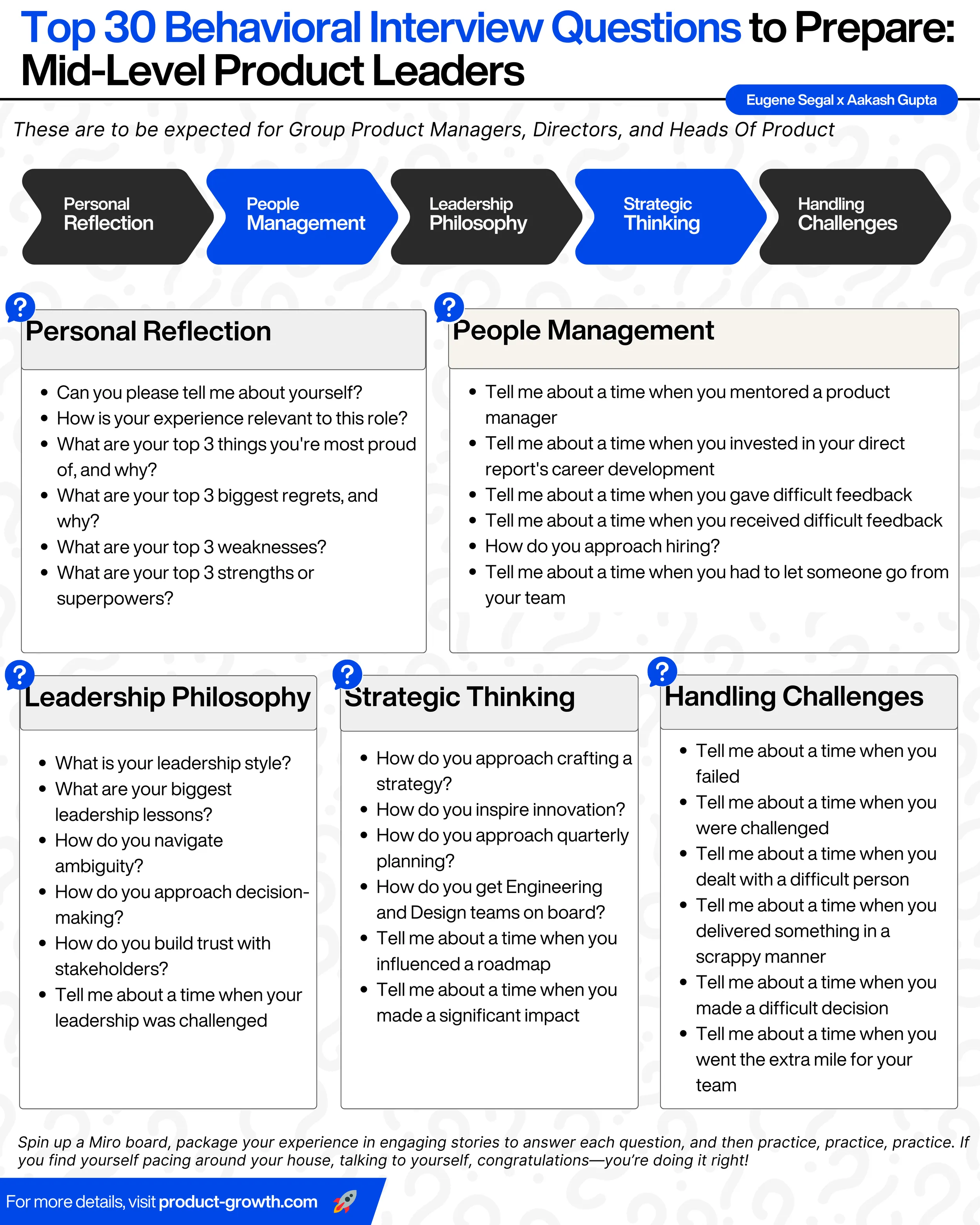
When preparing for product leadership interviews, most candidates focus on what stories to tell. But equally important is how these stories flow together to paint a complete picture of your leadership journey. Let’s explore how to master both.
The Foundation: Understanding the DIGS Method
Before diving into specific stories, let’s establish our storytelling framework. DIGS™ (Dramatize, Indicate alternatives, Go through, Summarize) isn’t just a structure—it’s a way to ensure your leadership narrative resonates authentically.
Think of DIGS as your story’s DNA:
- Dramatize: Set the stakes
- Indicate alternatives: Show your thinking
- Go through: Detail your actions
- Summarize: Connect to larger themes
Personal Reflection Stories: Where Leadership Begins
Every leadership journey starts with self-awareness. These stories form the foundation of your narrative, showing how you’ve grown from individual contributor to leader.
Example: The Pivot Point
Dramatize:
“Three months into leading our platform team, I noticed concerning scalability patterns. Our success—40% month-over-month growth—was hiding potential system breaking points. As a new leader, I faced my first real test of courage.”
Indicate alternatives:
“I could celebrate our growth and hope our systems held up. I could raise alarms and risk being seen as the person who rained on our parade. Or I could find a middle ground that addressed both the technical and human elements.”
Go through:
“I decided to reframe the conversation. Instead of presenting it as a problem, I gathered data showing how our growth trajectory would help us hit our annual goals two quarters early. Then I introduced the concept of ‘scaling ahead of growth’ as an opportunity to maintain our momentum.”
Summarize:
“We not only prevented a potential system failure but created a new growth readiness framework that became standard across our organization. More importantly, I learned that effective leadership isn’t about choosing between celebrating wins and addressing concerns—it’s about doing both simultaneously.”
Speaking of growth, this naturally leads us to how you develop others—your people management stories.
People Management Stories: From Self to Team Leadership
While personal reflection shows your individual growth, people management stories demonstrate how you multiply your impact through others.
Example: The Challenging Star
Dramatize:
“My most talented PM was delivering exceptional results but creating cross-team friction. Three engineering leads were considering leaving their projects because of his communication style. I had to choose between performance and culture.”
Indicate alternatives:
“I could focus on his results and downplay the interpersonal issues. I could escalate to HR and distance myself from the situation. Or I could take the harder path of addressing both the behavior and its root causes.”
Go through:
“I started by understanding his aspirations—he wanted to become a group PM. This gave us common ground to discuss how leadership skills would be crucial for his growth. We created a 90-day plan focusing on influence without authority, with weekly role-playing sessions and stakeholder feedback loops.”
Summarize:
“Within three months, he was not only maintaining his strong results but had become a mentor to junior PMs. The engineering leads who had considered leaving became his strongest advocates. Today, he’s a successful group PM, and we still use the development plan we created as a template for growing other leaders.”
As your people management stories show how you build teams, your leadership philosophy stories reveal how you guide them.
Leadership Philosophy Stories: Scaling Your Impact
Individual decisions become patterns. Patterns become philosophy. These stories show how you’ve developed and applied your leadership principles at scale.
Example: The Acquisition Challenge
Dramatize:
“Our company acquired a competitor with an overlapping product suite. My team of 15 was anxious about their future, and my counterpart’s team of 12 was equally concerned. We had no clear direction from executive leadership.”
Indicate alternatives:
“We could wait for top-down guidance and let uncertainty fester. We could compete to prove our team’s superior value. Or we could proactively create a collaborative solution that served both teams and our users.”
Go through:
“I reached out to my counterpart and proposed a joint task force. We created mixed teams focused on user value rather than organizational charts. Together, we mapped product overlaps, identified unique strengths, and developed three potential integration paths that maximized each team’s contributions.”
Summarize:
“Our approach became the blueprint for the entire integration. We retained 90% of both teams, increased user satisfaction by 35%, and created a new product line that neither team could have built alone. The experience taught me that leadership in uncertainty isn’t about having all the answers—it’s about creating the conditions for teams to find answers together.”
With strong leadership principles established, let’s examine how you apply them to strategic challenges.
Strategic Thinking Stories: Vision Meets Execution
Leadership philosophy guides decisions, but strategic thinking determines which decisions we face. These stories demonstrate your ability to see and shape the bigger picture.
Example: The Market Pivot
Dramatize:
“Our core product’s growth was stalling. We were hitting our targets through optimization, but competitor analysis revealed we were solving increasingly marginal problems while a major market shift was underway.”
Indicate alternatives:
“We could double down on optimization to hit near-term goals. We could copy our competitors’ features to stay relevant. Or we could take a bold step to redefine our category before someone else did.”
Go through:
“I initiated a three-part strategy: First, deep research into emerging user needs. Second, a capability audit of our team and technology. Third, a series of small experiments to test our hypotheses about the future. This led to identifying a crucial gap in the market that aligned perfectly with our core strengths.”
Summarize:
“The pivot increased our total addressable market by 300% and sparked 18 months of consecutive growth. But the real win was how it energized our team—we weren’t just building features anymore; we were shaping our industry’s future.”
Of course, even the best strategies face obstacles. This brings us to our final category.
Handling Challenges: Where Philosophy Meets Reality
Challenge stories bring everything together—personal growth, people management, leadership philosophy, and strategic thinking—showing how you navigate real-world complexity.
Example: The Failed Launch
Dramatize:
“Our biggest product launch of the year was failing. Early metrics showed 80% drop-off in our new user flow, and social media was filling with negative feedback. We had three days before our major press announcements.”
Indicate alternatives:
“We could proceed with the launch and manage expectations. We could delay everything and risk losing credibility. Or we could find a way to turn this crisis into an opportunity.”
Go through:
“I gathered our core team and our most vocal critics from social media for an emergency feedback session. We discovered our innovative UI, which internal users loved, was confusing for new users. We spent 48 straight hours simplifying the experience while maintaining its power.”
Summarize:
“We launched on schedule with a much better product. Our transparency about the last-minute changes earned us praise from users and press alike. Most importantly, we learned to balance innovation with accessibility, a principle that now guides all our design decisions.”
Bringing It All Together: Your Leadership Narrative
Notice how each category builds upon the previous ones, creating a coherent leadership story:
- Personal reflection provides the foundation
- People management shows how you scale through others
- Leadership philosophy demonstrates your guiding principles
- Strategic thinking reveals your business acumen
- Challenge stories prove your resilience
Preparation Strategy: Crafting Your Story Web
Rather than preparing stories in isolation, consider how they interconnect:
- Map your experiences across categories
- Identify themes that connect different stories
- Practice transitions between related stories
- Develop stories that showcase multiple competencies
Final Thoughts: Beyond Individual Stories
The most successful product leadership interviews don’t just present a collection of good stories—they weave those stories into a compelling leadership narrative. As you prepare, focus not just on individual stories, but on how they connect to paint a complete picture of you as a leader.
Remember: Every story should reinforce your core themes while highlighting different aspects of your leadership. Practice until you can move fluidly between stories, adapting to the conversation while maintaining a clear through-line of your leadership journey.