The NEW Process at a Glance
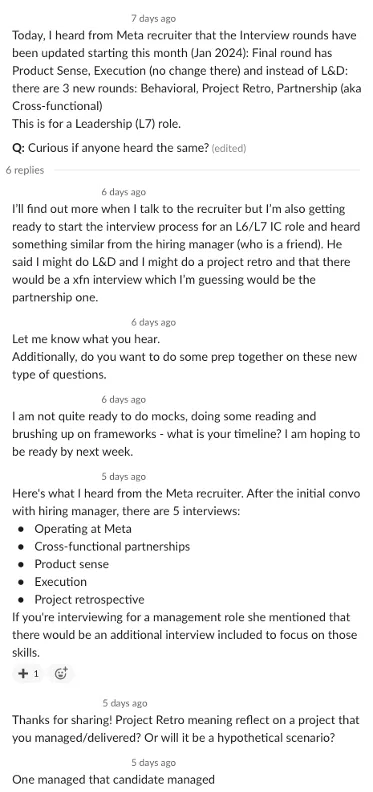
According to a Meta recruiter, after your initial conversation with the hiring manager, you’ll face five distinct interviews:
- Operating at Meta
- Cross-functional Partnerships
- Product Sense
- Product Execution
- Project Retrospective
Note: Management track candidates receive an additional leadership-focused round.
Why This Matters Now
Meta’s interview overhaul represents a significant shift in how tech giants evaluate senior talent. As the company pushes into AI, the metaverse, and beyond, they’re not just assessing technical capabilities – they’re identifying leaders who can navigate unprecedented challenges at scale.
This new process reflects Meta’s evolving needs: leaders who can drive technical innovation while managing complex stakeholder relationships, scale products responsibly, and adapt quickly in uncertain environments.
Breaking Down Each Round
Operating at Meta
This round evaluates your ability to navigate Meta’s unique culture and challenges. You’ll need stories that demonstrate:
- Rapid decision-making in ambiguous situations
- Scaling challenges and solutions
- Culture-building and change management
Example Story Using DIGS Method:
Dramatize:
“Our gaming division was hemorrhaging users – 20,000 daily players lost in a month. The board was pressuring us to revert to our old monetization strategy, but I knew that would only accelerate the decline.”
Indicate alternatives:
“We could double down on ads, switch to a subscription model, or rebuild our entire engagement loop. Each path had vocal supporters and significant risks.”
Go through:
“I launched what we called ‘Project Player Voice’ – embedding our product team directly in gaming communities for two weeks. We discovered our power users were actually creating underground tournaments with their own prize pools. This sparked an idea: official tournament infrastructure with revenue sharing.”
Summarize:
“Within three months, player retention improved by 40%, and our new tournament platform generated $2M in its first quarter. More importantly, we built a sustainable ecosystem where player success directly contributed to business success.”
Cross-functional Partnerships
This round explores your ability to influence without authority and drive results across teams. Focus on stories that show:
- Complex stakeholder management
- Conflict resolution
- Building consensus across diverse teams
Example Story:
Dramatize:
“During the height of COVID, our education platform suddenly faced unprecedented demand – 300,000 new students needed access, but our non-profit partners were struggling with limited resources.”
Indicate alternatives:
“Traditional solutions wouldn’t work: waiting for more funding would leave students behind, rushing our existing systems would risk crashes, and limiting access seemed wrong.”
Go through:
“I assembled an unusual coalition: our engineering team, three competing education non-profits, and local government IT departments. We created shared resource pools, developed emergency scaling protocols, and built a cross-organization support system.”
Summarize:
“We supported all 300,000 students without a single major outage. The partnership model we created became a blueprint for crisis response, later adopted by education platforms in twelve countries.”
Product Sense & Execution
These rounds evaluate your product thinking and ability to deliver results. Prepare stories about:
- Strategic product decisions
- Resource allocation and prioritization
- Handling technical debt while scaling
Example Story:
Dramatize:
“Our biggest retail client threatened to leave our platform, putting $50M in annual revenue at risk. Their complaint? Our competitor’s new pricing model was 40% cheaper.”
Indicate alternatives:
“We could match the pricing and hurt our margins, maintain our premium position and risk losing the client, or try to find middle ground with bundle deals.”
Go through:
“Instead of focusing solely on price, I led a deep-dive into their business metrics. We discovered they were actually losing money on small transactions. I worked with our data team to create a dynamic pricing model that optimized their profit per transaction.”
Summarize:
“Not only did we retain the client, but our new pricing model increased their profitability by 25%. We’ve since rolled out similar models to our entire retail segment, growing that division’s revenue by $120M annually.”
Preparation Strategy
1. Story Bank Development
Map your experiences across these dimensions:
- Business Impact (revenue, growth, efficiency)
- Technical Innovation (scale, architecture, products)
- People Leadership (team building, influence, change)
2. Meta Context
- Study recent product launches and strategic shifts
- Understand Meta’s current challenges and opportunities
- Research your target team’s specific focus
3. Impact Framework
For each story, prepare:
- Quantitative metrics (revenue, users, efficiency)
- Qualitative outcomes (team health, cultural change)
- Long-term impact (strategic shifts, new capabilities)
Keys to Success
- Show Scale Thinking
- Demonstrate how your solutions can work at Meta’s level
- Address both immediate and long-term implications
- Consider global and cross-platform impacts
- Emphasize Learning
- Share how failures shaped your approach
- Highlight pattern recognition across experiences
- Show ability to adapt strategies based on new information
- Connect to Meta’s Mission
- Link your experiences to Meta’s current challenges
- Show understanding of Meta’s unique constraints
- Demonstrate alignment with Meta’s values
Final Thoughts
Meta’s new interview process seeks leaders who can shape the future of technology while navigating complex organizational challenges. Success comes from authentically sharing experiences that demonstrate your ability to drive impact at scale.
Remember: Your stories should show not just what you achieved, but how you thought through problems and brought others along on the journey. Focus on clear communication, strategic thinking, and authentic leadership presence.