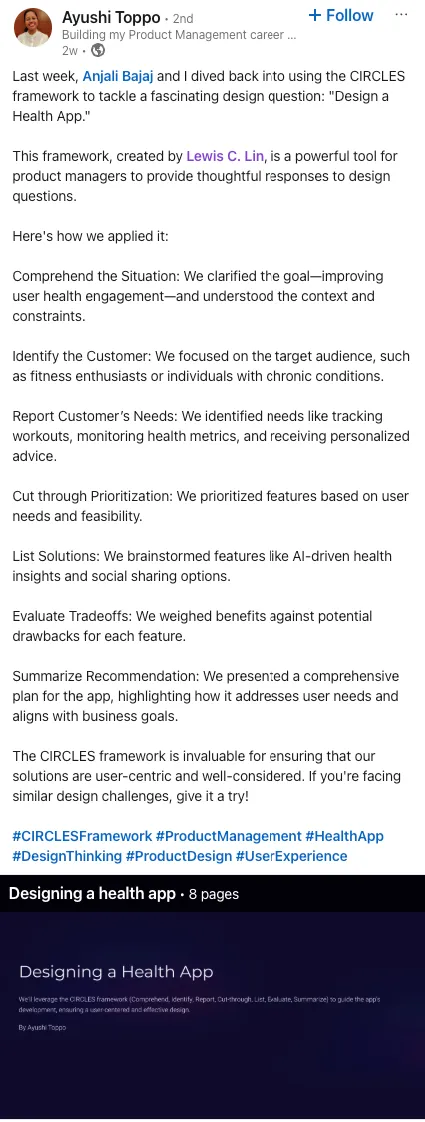
I’m always excited to see the CIRCLES framework being implemented across companies and organizations of all sizes. Whether it’s a startup shaping its first product or an established company refining its roadmap, structured thinking leads to better outcomes.
Recently, Anjali and a colleague put the framework to work on an intriguing design challenge:
“Design a Health App.”
Using CIRCLES, they navigated this challenge with clarity and precision. Here’s how they applied each step:
✅ Comprehend the Situation – They first defined the app’s core purpose: improving user health engagement while considering context and constraints.
✅ Identify the Customer – Who benefits from this solution? They pinpointed fitness enthusiasts and individuals managing chronic conditions as key users.
✅ Report Customer’s Needs – They mapped out essential needs, from tracking workouts to monitoring health metrics and receiving personalized recommendations.
✅ Cut through Prioritization – Not all features carry equal weight. They prioritized based on what would provide the most value and feasibility.
✅ List Solutions – Their brainstorming led to powerful ideas, such as AI-driven health insights and social-sharing functionalities to boost motivation.
✅ Evaluate Tradeoffs – Every decision has pros and cons. They carefully weighed the benefits and potential challenges of each feature.
✅ Summarize Recommendation – Finally, they put it all together, crafting a well-rounded plan that aligns with both user needs and business objectives.
This is exactly why the CIRCLES framework exists—to guide structured, user-centric product thinking. Seeing it in action like this is a reminder of how powerful it can be.
If you’re tackling a product challenge, whether small or large, I encourage you to apply the CIRCLES framework and see the impact for yourself. 🚀
Have a story about using CIRCLES? I’d love to hear it!