Introduction
Every year, companies worldwide pour millions of labor hours into manual invoice processing—copy-pasting numbers, wrangling PDFs, chasing down exceptions. These repetitive tasks drain resources and introduce costly errors, especially when invoices arrive in dozens of layouts, languages, or even handwriting. Uber faced exactly this challenge. By replacing brittle RPA scripts with a Generative AI engine, they slashed handling time by 70%, doubled throughput, and unlocked 25–30% in cost savings. In this post, we’ll unpack how they did it, why RPA alone falls short, and which business processes are ripe for a similar GenAI makeover.
1. Case Study Deep-Dive: Uber’s Transformation
The Limits of RPA + Rule-Based Systems
Initially, Uber relied on a typical RPA playbook:
-
Email & Portal Intake
- Suppliers emailed invoices or used an in-house portal.
-
RPA Extraction
- Bots grabbed attachments, ran OCR, then applied hard-coded “if/then” rules to pull fields.
-
Manual Exceptions
- Whenever a layout changed—or a vendor submitted a handwritten note—work piled up on human desks.
Pain Points quickly emerged:
- Brittle Logic: One vendor tweak could break the entire script.
- Maintenance Overhead: Each new supplier meant a fresh round of rule-writing.
- Scalability Barriers: RPA handled only a handful of invoice templates; 25 languages and scanned images overwhelmed it.
Enter GenAI: The TextSense Pipeline
To solve this, Uber built TextSense, a GenAI-powered document platform with these core steps:
-
Ingest & Pre-process
- Emails, uploads, low-res scans—all funneled into a single pipeline that cleans and standardizes inputs.
-
OCR & Computer Vision
- Uber’s Vision Gateway translates pixels (including handwriting) into raw text.
-
Generative AI Extraction
- GPT-4 models “read” the invoice like a human, semantically identifying invoice numbers, dates, line items, and totals—even when formats deviate.
-
Post-processing & Validation
- Business rules catch anomalies; borderline cases route to a Human-in-the-Loop (HITL) review UI that displays the PDF side-by-side with extracted data.
-
ERP Integration
- Clean, validated data streams directly into Uber’s accounting systems, eliminating copy-paste errors.
The payoff was immediate and dramatic:
- 90% average extraction accuracy
- 2× reduction in manual invoicing
- 70% cut in handling time
- 25–30% cost savings vs. manual processing
2. Why RPA Alone Isn’t Enough
RPA’s strength lies in automating routine, structured tasks—but invoices are anything but routine when formats vary widely. Here’s where bots stumble:
-
Brittle Logic
- Hard-coded rules (“if header = Acme Corp, then field = amount”) break the moment Acme tweaks their template.
-
Maintenance Overhead
- Scaling RPA means endless script updates and more automation engineers pulling late nights.
-
Exception Overload
- High exception rates send tasks right back to humans, eroding any efficiency gains.
In contrast, Generative AI learns from context, adapts to new patterns, and continuously improves through feedback loops—qualities RPA lacks by design.
3. The Generative AI Opportunity
Is Your Process a GenAI Candidate?
Not every workflow needs an LLM under the hood. But if yours ticks these boxes, GenAI is worth a look:
- High Format Variability: Documents come in wildly different layouts or languages.
- Large Volumes: You process thousands (or millions) of items monthly.
- Existing HITL Steps: You already have humans reviewing exceptions.
Signs You’re Ready
- You spend more time updating OCR or RPA scripts than innovating.
- Exception logs outnumber successful automations.
- You’ve piloted basic NLP/OCR but still rely on manual fixes.
By layering GenAI atop your OCR pipeline, you gain semantic understanding—the ability to interpret meaning, not just pixels—dramatically reducing exceptions and maintenance.
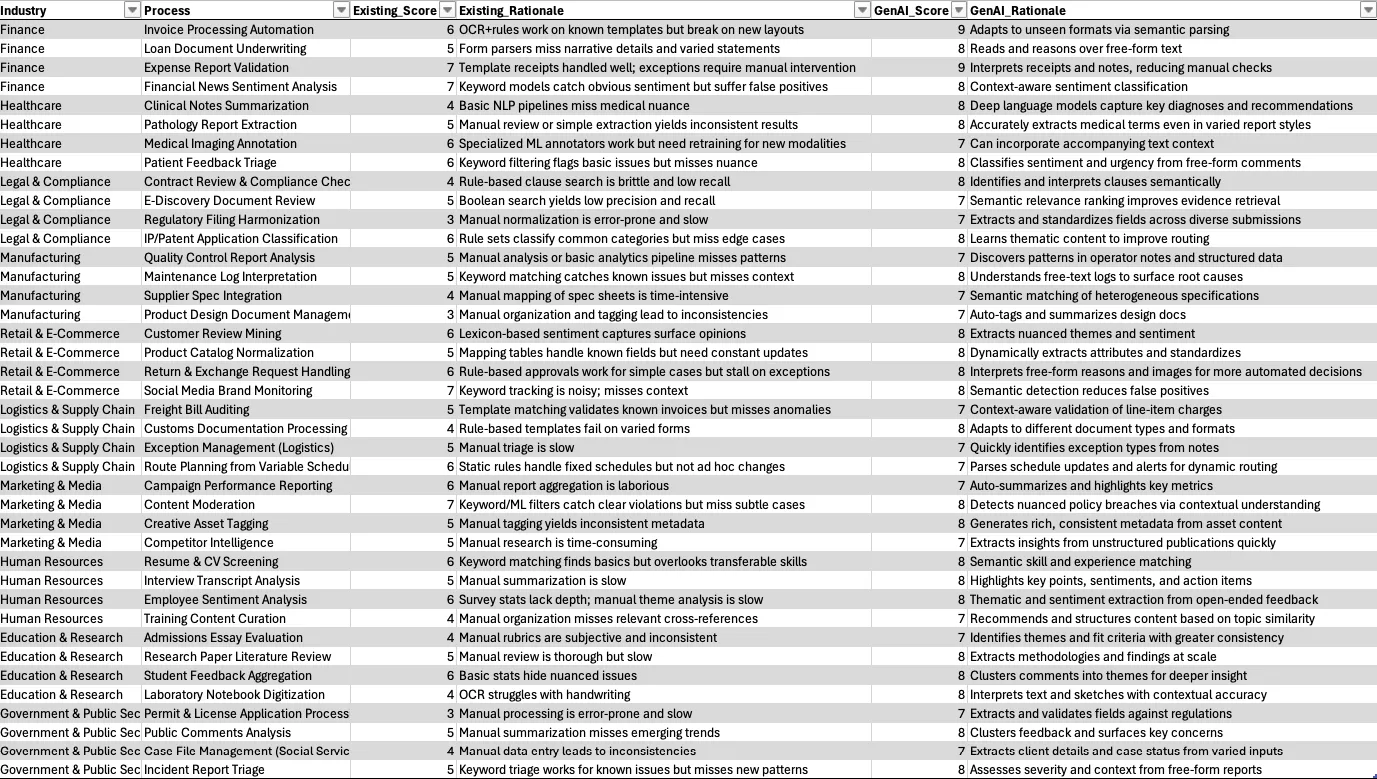
4. 40 High-Variance Processes to Automate
Below is a comprehensive, industry-grouped table showcasing 40 real-world processes that wrestle with unstructured, high-variance data. For each, you’ll see:
- Existing Solutions (1–10): How well current OCR, RPA, rule-based, or basic ML tools handle it.
- Generative AI (1–10): The uplift potential from fine-tuned LLMs.
- Rationales explaining each score.
5. Practical Next Steps
-
Pilot a GenAI PoC
- Choose one high-volume, high-variance process (e.g., invoices, resumes, survey comments).
- Integrate your existing OCR pipeline with a fine-tuned LLM for extraction.
-
Build Feedback Loops
- Route low-confidence extractions through a simple HITL UI.
- Continuously retrain the model on corrected outputs.
-
Measure & Iterate
- Track key metrics: extraction accuracy, exception rate, processing throughput, and cost savings.
- Expand to adjacent processes once you hit > 90% accuracy and see clear ROI.
Conclusion & Call to Action
Uber’s leap from fragile RPA to robust Generative AI demonstrates how semantic understanding can finally tame unstructured, high-variance workflows at scale. By combining the speed of automation with the judgment of human-in-the-loop review, organizations unlock dramatic efficiency gains—and free people for higher-value work.